A short history
Roger Ground & Hawkshead
A hamlet of slate, oak and lime-washed stone tucked between Esthwaite Water and the fells. Small in size, big in story — and a place the poet William Wordsworth knew well.
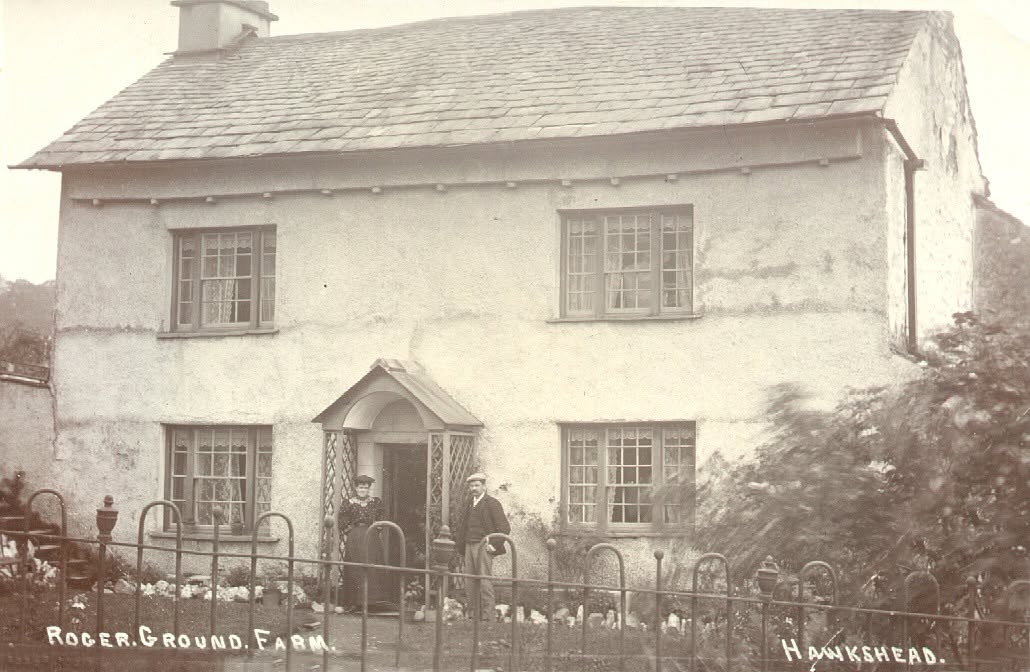
Wordsworth walked past your door
William Wordsworth was sent to Hawkshead Grammar School in 1779, aged nine, and lodged in the village with Ann Tyson. His daily walks took him out along the lanes and shorelines around Esthwaite Water — and that meant past the cluster of farms at Roger Ground. The path he would have known is largely the path you walk today.
Local tradition holds that one of his Hawkshead schoolmasters lived in what is now Roger Ground House. We can't prove it with a parish ledger, but the building, the era and the daily routine all fit. It's a nice thought to carry with you in the morning.
Who was Roger?
The honest answer: nobody knows for certain. The "Roger" of Roger Ground is most likely a medieval tenant farmer — a Roger who, at some point in the 1300s or 1400s, cleared and enclosed this particular patch of fellside from the surrounding waste. His name stuck to the land long after he was forgotten.
This is how a lot of Lakeland place-names work: a person, a feature and a use, welded together by centuries of use until they became one word on a map.
Why so many "Grounds" around Hawkshead?
Walk a mile in any direction from Hawkshead and you'll meet them: Roger Ground, Keen Ground, Borwick Ground, Hodge Ground, Walker Ground, Outgate Ground. "Ground" here is a north-country farming word for an enclosed parcel of landtaken in from the common fell — what elsewhere might be called an intake, allotment or close.
Most were carved out under the medieval and Tudor estates of Furness Abbey, whose monks ran a sprawling sheep economy across High Furness from the 12th century until the Dissolution in 1537. After the abbey fell, its tenants bought their holdings outright and became the statesmen — the small independent yeoman farmers whose whitewashed longhouses still define this corner of the Lakes.
Vernacular architecture: what to look for on your walks
The buildings around Roger Ground are a textbook of Lakeland vernacular — built from what was to hand, by people who weren't trying to impress anyone. A few things worth noticing:
Slate fences
Instead of post-and-rail, field boundaries here are often made from upright slabs of Brathay or Coniston slate, set on edge into the ground and wired together. They're a south-Lakes speciality — quick to put up where stone was cheaper than timber, and almost indestructible. Look for them between Hawkshead and Outgate, and along the lanes to Near Sawrey.
Cumbrian spice cupboards
Built into the chimney breast of many 17th- and 18th-century farmhouses, the spice cupboard is a small oak door — often beautifully carved with initials, a date and stylised flowers or vines — that hides a warm, dry recess beside the fire. It kept salt, sugar, pepper and the precious imported spices that arrived through the port of Whitehaven dry through a Lakeland winter. They're a point of pride: a yeoman farmer's quiet showpiece.
Porches with slate roofs & lattice surrounds
The classic Hawkshead porch is a small, gabled entrance with a thin slate roof, often supported on wooden brackets, and a wooden lattice or trellis on either side — sometimes painted, sometimes left to weather. It shelters the door from the prevailing south-westerlies, gives roses and clematis somewhere to climb, and is one of the most photographed details in the village. Once you spot the pattern, you'll see it on cottage after cottage.
And while you're looking…
Round-headed cylindrical chimneys, white lime-washed walls under slate roofs hung with heavy "watershot" courses, mounting blocks by the gate, datestones above the door with husband-and-wife initials. None of it is grand. All of it is here on purpose.
Further reading
- Hawkshead Grammar School Museum — where Wordsworth was educated, now a small museum in the village.
- Hawkshead on Visit Cumbria — a good overview of the village's history.
- Discover more — books, podcasts and films about the area.